


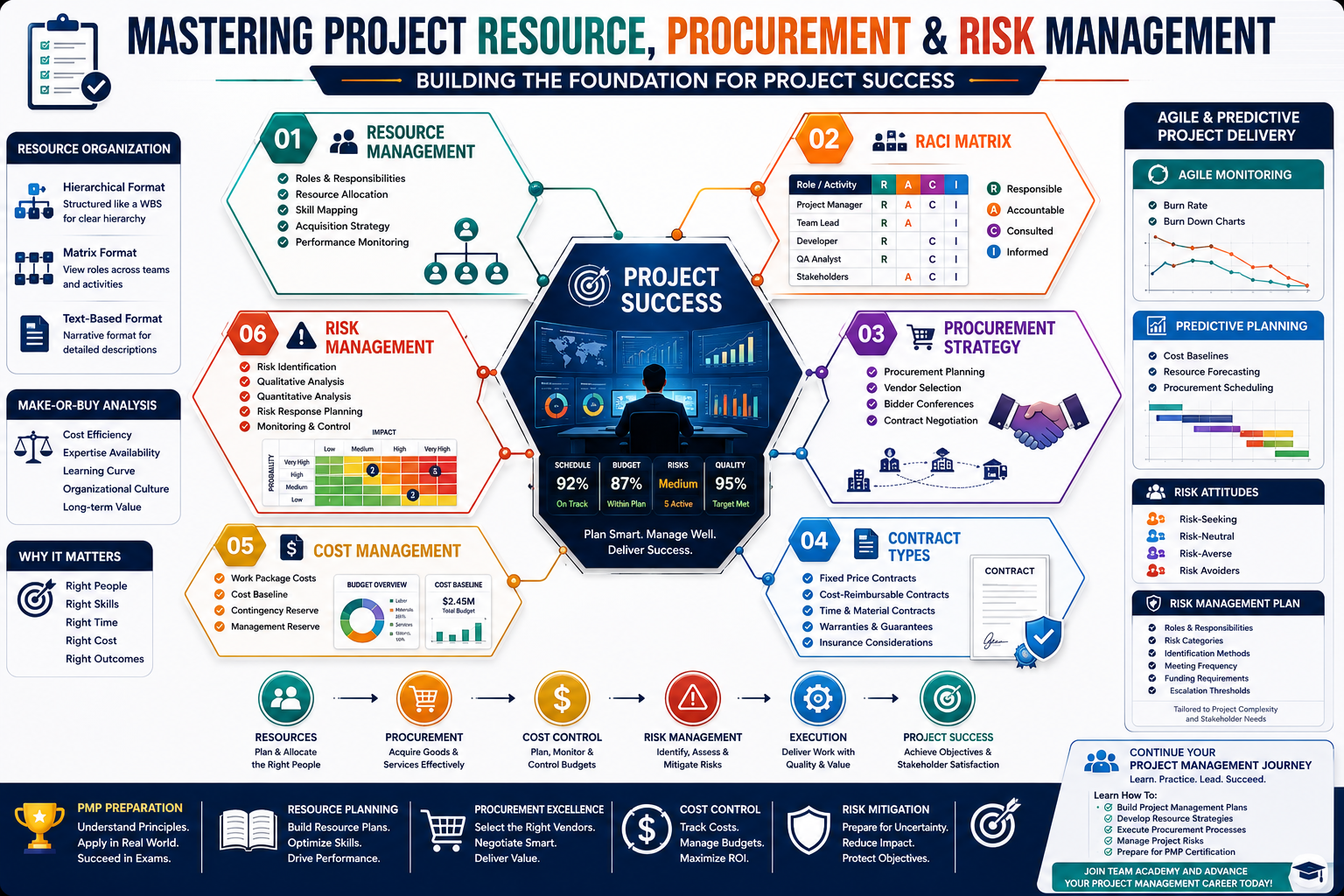
Successful projects are not built on technical expertise alone—they depend on effective planning, resource allocation, procurement strategies, and risk management.
In this advanced project management session, participants explored key concepts from predictive and Agile project lifecycles, focusing on resource management plans, procurement strategies, cost management, and risk management frameworks that drive project success.
The session provided practical insights aligned with PMP principles and real-world project execution.
👥 Resource Management: Putting the Right People in the Right Roles
One of the central topics covered was the Resource Management Plan, a critical component of project planning.
Participants learned that a resource management plan defines:
✅ Project roles and responsibilities
✅ Required skills and competencies
✅ Reporting structures
✅ Resource acquisition strategies
✅ Monitoring and control mechanisms
Effective resource planning ensures that projects have the right people, at the right time, with the right skills.
📊 Organizing Resources Effectively
The class introduced three common formats for organizing project resources:
🏗️ Hierarchical Format
Similar to a Work Breakdown Structure (WBS), this approach organizes resources in a structured hierarchy.
📋 Matrix Format
Provides a clear view of responsibilities across different teams and activities.
📝 Text-Based Format
Documents resource details in narrative form.
Each format serves different project needs depending on complexity and stakeholder requirements.
🎯 Eliminating Ambiguity with RACI Matrices
A major focus of the session was the RACI Matrix, one of the most valuable tools in project management.
RACI stands for:
-
Responsible – Performs the work
-
Accountable – Owns the outcome
-
Consulted – Provides input
-
Informed – Receives updates
Using a RACI matrix helps teams:
✔ Clarify responsibilities
✔ Reduce confusion
✔ Improve accountability
✔ Strengthen communication
Well-defined roles lead to more efficient project execution and fewer conflicts.
🔄 Make-or-Buy Decisions: Strategic Resource Planning
Organizations often face a key question:
Should we perform the work internally or outsource it?
Participants explored Make-or-Buy Analysis, considering factors such as:
-
Cost efficiency
-
Availability of expertise
-
Learning curves
-
Organizational culture
-
Long-term business value
The session emphasized that outsourcing decisions should consider not only cost but also productivity, quality, and integration challenges.
🛒 Procurement Management: Acquiring the Right Resources at the Right Time
Procurement is more than purchasing—it is strategic project planning.
Key concepts included:
Procurement Planning
Identifying what goods or services are required.
Vendor Selection
Evaluating suppliers based on predefined criteria.
Bidder Conferences
Clarifying project requirements before bids are submitted.
Contract Negotiation
Finalizing commercial and technical terms.
Participants learned that procurement timing must align with project schedules to avoid delays and cost overruns.
📑 Understanding Contract Types
The session covered three major contract categories used in project environments:
Fixed Price Contracts
Best suited for clearly defined scopes.
Cost-Reimbursable Contracts
Used when scope uncertainty exists.
Time & Material Contracts
Ideal for flexible or evolving requirements.
Participants also explored concepts such as warranties, guarantees, and insurance as part of overall project costs.
💰 Cost Management: Controlling Project Finances
Effective projects require strong financial planning.
Participants learned about the three major components of project budgets:
1️⃣ Work Package Costs
The estimated cost of project activities.
2️⃣ Contingency Reserve
Funds allocated for identified risks.
3️⃣ Management Reserve
Funds reserved for unforeseen risks.
The discussion highlighted the distinction between:
-
Cost Management Plan → Defines processes and guidelines.
-
Cost Baseline → Contains approved budget values.
Understanding this difference is essential for PMP preparation and project governance.
📈 Agile Cost Monitoring
The session also explored how Agile projects monitor costs using:
Burn Rate
Measures the speed at which budgets are consumed.
Burn-Down Charts
Track remaining work over time.
These tools help Agile teams maintain transparency and respond quickly to changes.
⚠️ Risk Management: Preparing for Uncertainty
No project is free from risk.
Participants were introduced to the seven key risk management processes, including:
✅ Risk Identification
✅ Qualitative Analysis
✅ Quantitative Analysis
✅ Risk Response Planning
✅ Monitoring & Control
A project risk was defined as:
An uncertain event or condition that can positively or negatively impact project objectives.
Understanding project scope remains the first step toward identifying meaningful risks.
🎯 Understanding Risk Attitudes
Different stakeholders respond differently to uncertainty.
The session covered common risk attitudes:
-
Risk-Seeking
-
Risk-Neutral
-
Risk-Averse
-
Risk Avoiders
Recognizing stakeholder risk preferences helps project managers design appropriate response strategies.
🛡️ Building a Risk Management Plan
Participants learned that an effective Risk Management Plan should define:
✔ Roles and responsibilities
✔ Risk categories
✔ Identification methods
✔ Meeting frequency
✔ Funding requirements
✔ Escalation thresholds
Importantly, risk management should always be tailored to project complexity and stakeholder expectations.
🎓 PMP Preparation Through Real-World Practice
The session reinforced the importance of understanding principles rather than memorizing concepts.
Upcoming classes will include:
📚 PMP Practice Questions
📊 Real Project Scenarios
📝 Exam-Oriented Discussions
This practical approach helps learners apply project management concepts confidently in both examinations and workplace environments.
🚀 Why These Skills Matter
Organizations increasingly seek professionals who can:
📋 Manage Resources Efficiently
🛒 Execute Procurement Strategies
💰 Control Budgets
⚠️ Mitigate Risks
📊 Deliver Projects Successfully
These competencies are essential across industries including construction, IT, oil & gas, healthcare, and business transformation.
🎯 Continue Your Project Management Journey
At Team Academy, learning extends beyond theory into real-world application.
Learn How To:
✅ Build Project Management Plans
✅ Develop Resource Strategies
✅ Execute Procurement Processes
✅ Manage Project Risks
✅ Prepare for PMP Certification
The future belongs to professionals who can plan effectively, manage uncertainty, and deliver successful outcomes.
📩 Join Team Academy and advance your project management career today.


