


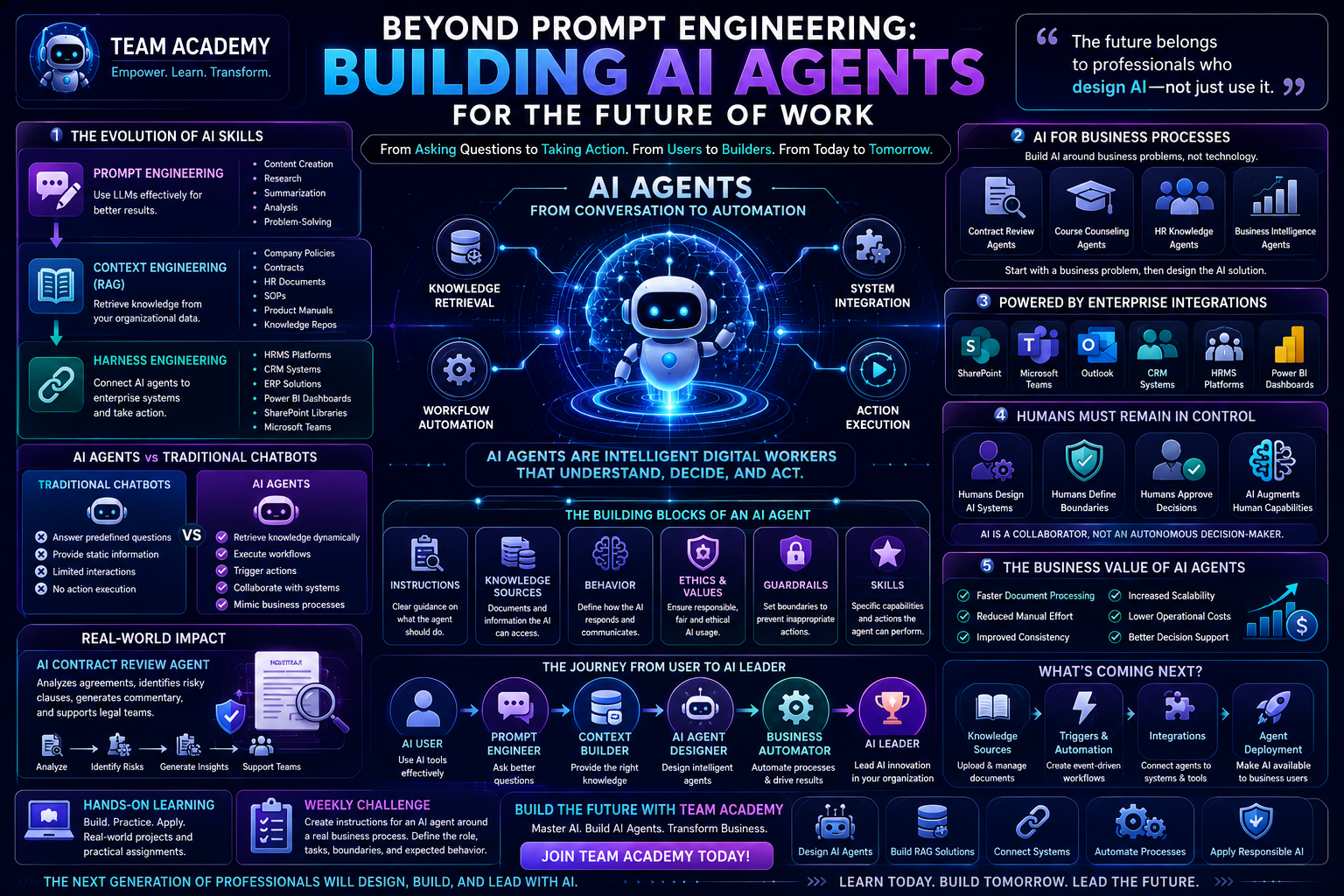
Artificial Intelligence is rapidly evolving from simple chatbots into intelligent digital workers capable of retrieving knowledge, executing tasks, and supporting business operations.
In this advanced Team Academy session, participants explored the next frontier of AI implementation: AI Agents and Context Engineering. The class introduced learners to the evolution of AI from basic prompting to enterprise-grade automation and intelligent assistants.
The session emphasized one powerful message:
The future belongs to professionals who design AI—not just use it.
🚀 The Evolution of AI Skills
The session began by introducing three key domains shaping the future of Artificial Intelligence:
✍️ Prompt Engineering
Using Large Language Models (LLMs) effectively for:
-
Content creation
-
Research
-
Summarization
-
Analysis
-
Problem-solving
Prompt engineering focuses on asking AI the right questions and providing clear instructions.
📚 Context Engineering (RAG)
The next evolution is Context Engineering, also known as Retrieval-Augmented Generation (RAG).
Instead of relying on general internet knowledge, AI agents can retrieve information from:
-
Company policies
-
Contracts
-
HR documents
-
SOPs
-
Product manuals
-
Knowledge repositories
This enables organizations to create highly specialized AI assistants tailored to their business needs.
🔗 Harness Engineering
The most advanced stage introduced was Harness Engineering.
This involves connecting AI agents to enterprise systems such as:
✅ HRMS Platforms
✅ CRM Systems
✅ ERP Solutions
✅ Power BI Dashboards
✅ SharePoint Libraries
✅ Microsoft Teams
At this stage, AI moves beyond answering questions and begins performing actions on behalf of users.
🤖 AI Agents vs Traditional Chatbots
Participants explored the critical difference between chatbots and AI agents.
Traditional Chatbots
-
Answer predefined questions
-
Provide static information
-
Limited interactions
AI Agents
-
Retrieve knowledge dynamically
-
Execute workflows
-
Trigger actions
-
Collaborate with systems
-
Mimic business processes
AI agents represent a major shift from conversation to automation.
🏢 Building AI for Business Processes
A key theme throughout the session was that organizations should build AI around business processes—not technology.
Examples of AI use cases discussed included:
📑 Contract Review Agents
Analyzing agreements and identifying risky clauses.
🎓 Course Counseling Agents
Providing personalized learning guidance.
👥 HR Knowledge Agents
Answering policy-related questions using company documents.
📊 Business Intelligence Agents
Interacting with dashboards and enterprise data.
The emphasis was clear:
Start with a business problem, then design the AI solution.
🧠 The Building Blocks of an AI Agent
Participants learned that every professional AI agent requires several essential components:
Instructions
Clear guidance on what the agent should do.
Knowledge Sources
The documents and information the AI can access.
Behavior
Defining how the AI responds.
Ethics & Values
Ensuring responsible AI usage.
Guardrails
Preventing inappropriate actions or responses.
Skills
Specific capabilities assigned to the AI.
These components ensure AI remains aligned with organizational goals and compliance requirements.
⚖️ Humans Must Remain in Control
An important discussion centered on AI governance.
The session reinforced that:
✔ Humans design AI systems
✔ Humans define boundaries
✔ Humans approve decisions
✔ AI augments human capabilities
AI should act as a collaborator—not an autonomous decision-maker.
Responsible AI implementation remains essential for long-term success.
💰 The Business Value of AI Agents
One real-world case study demonstrated how an AI-powered contract review process significantly improved operational efficiency.
Benefits of AI agents may include:
-
Faster document processing
-
Reduced manual effort
-
Improved consistency
-
Increased scalability
-
Lower operational costs
These examples highlighted why organizations worldwide are investing heavily in AI automation initiatives.
🌐 Choosing the Right AI Platform
Participants explored multiple AI platforms used for creating agents and custom assistants.
Different tools serve different purposes depending on:
-
Complexity of analysis
-
Knowledge retrieval needs
-
Integration requirements
-
Enterprise deployment scenarios
The session emphasized that success depends less on the platform and more on designing effective instructions and workflows.
📝 Why Human-Written Instructions Matter
One of the most valuable lessons from the class was the importance of creating instructions manually.
AI-generated instructions may provide a starting point, but business users possess the contextual knowledge needed to design truly effective agents.
Participants were encouraged to:
✅ Define business objectives
✅ Map workflows manually
✅ Identify decision points
✅ Specify expected outcomes
Strong instructions create strong AI agents.
🎯 Hands-On Assignment: Build Your First AI Agent
As part of the learning journey, participants were assigned a practical exercise:
Create instructions for an AI agent designed around a real business process.
The focus is not on coding—but on:
-
Defining the role
-
Describing responsibilities
-
Setting boundaries
-
Specifying tasks
-
Establishing expected behavior
This assignment helps learners think like AI designers and solution architects.
🚀 What’s Coming Next?
Upcoming sessions will cover:
📚 Knowledge Sources
Uploading and managing documents.
🔄 Triggers & Automation
Creating event-driven workflows.
🔗 Integrations
Connecting agents to Teams, SharePoint, and enterprise systems.
🤖 Agent Deployment
Making AI available to business users.
Participants will continue progressing from AI users to AI builders.
🌟 Why AI Agent Skills Matter
Organizations are rapidly adopting AI-driven automation.
Professionals who understand:
📌 Prompt Engineering
📌 Context Engineering
📌 RAG Architectures
📌 AI Governance
📌 Agent Design
📌 Business Automation
will be among the most sought-after professionals in the digital economy.
The future of work is not about competing with AI—it is about learning how to build and manage it.
🎯 Build the Future with Team Academy
At Team Academy, learning goes beyond theory into real-world AI implementation.
Learn How To:
✅ Design AI Agents
✅ Build RAG Solutions
✅ Connect Enterprise Systems
✅ Automate Business Processes
✅ Apply Responsible AI Practices
The next generation of digital transformation leaders will be those who can successfully combine business knowledge with AI capabilities.
📩 Join Team Academy and start building the future today.


